
On-demand webinar coming soon...


On-demand webinar coming soon...

Blog

How CISOs Can Secure and Govern AI Across the Enterprise

Security leaders can govern, secure, and scale AI safely with inventories, policy enforcement, and continuous monitoring. 


Jason Koestenblatt
Senior Manager, Content Marketing
July 6, 2026

Person standing on a modern office balcony using a mobile device, representing digital governance and AI compliance planning.

Artificial intelligence is a permanent part of the enterprise technology stack. Employees are using generative AI to increase productivity, vendors are building AI into existing products, and organizations are exploring increasingly autonomous systems that can take action on behalf of users. As AI adoption accelerates, security leaders face a new challenge: governing AI at the same pace it’s being deployed.

The conversation has evolved beyond how AI can help detect threats or automate security operations. Today's challenge is understanding where AI exists across the organization, what data it accesses, how it influences decisions, and what controls are needed to manage risk. AI governance has become a core security responsibility.

Organizations that succeed in the next phase of AI adoption will move beyond policy documents and manual reviews. They will embed governance directly into workflows, systems, and decision-making processes. This shift toward governance by design allows organizations to scale AI innovation while maintaining visibility, accountability, and control.


Key Takeaways From the Blog

  • AI governance has become a critical security and business priority.
  • Organizations need a complete inventory of AI systems, models, and vendors operating across the enterprise.
  • Structured AI intake and review processes help balance innovation with risk management.
  • AI governance should extend throughout the technology lifecycle through continuous monitoring and oversight.
  • Agentic AI introduces new governance challenges that require runtime controls and observability.
  • Governance should enable AI adoption, not slow it down.


Why AI Governance Has Become a Security Priority

The security conversation around AI has changed dramatically over the last two years.

Early discussions focused on productivity gains and individual use cases. Today, security leaders are asking broader questions. What AI systems exist across the organization? What data is being shared with those systems? Which vendors are using AI on the organization's behalf? How are AI-generated outputs influencing business decisions? Most importantly, how can organizations manage risk at scale?

These questions are becoming increasingly difficult to answer as AI spreads throughout the enterprise. AI capabilities are now embedded across customer service platforms, productivity suites, software development tools, security products, analytics systems, and third-party applications. In many cases, AI adoption is occurring faster than traditional governance processes can keep up.

At the same time, regulatory scrutiny is increasing. Organizations are expected to demonstrate accountability, transparency, and oversight across the AI lifecycle. Security teams are increasingly finding themselves at the center of these conversations because AI risk touches data protection, cyber resilience, third-party risk, compliance, and operational governance.

For many CISOs, AI governance is becoming as foundational as cloud governance was a decade ago.


Start With an AI Inventory

Before organizations can govern AI, they need visibility.

Many enterprises underestimate the number of AI systems operating across their environment. Beyond approved applications, AI capabilities are increasingly embedded within SaaS platforms, productivity tools, development environments, security technologies, customer-facing applications, and third-party services. As a result, most organizations have significantly more AI exposure than they realize.

This visibility gap creates one of the most immediate governance challenges. Security and governance teams cannot assess risk, implement controls, or monitor usage if they do not know where AI exists.

A centralized AI inventory serves as the foundation for governance. It provides a system of record that captures AI use cases, deployed models, data sources, vendors, business owners, risk classifications, and applicable controls.
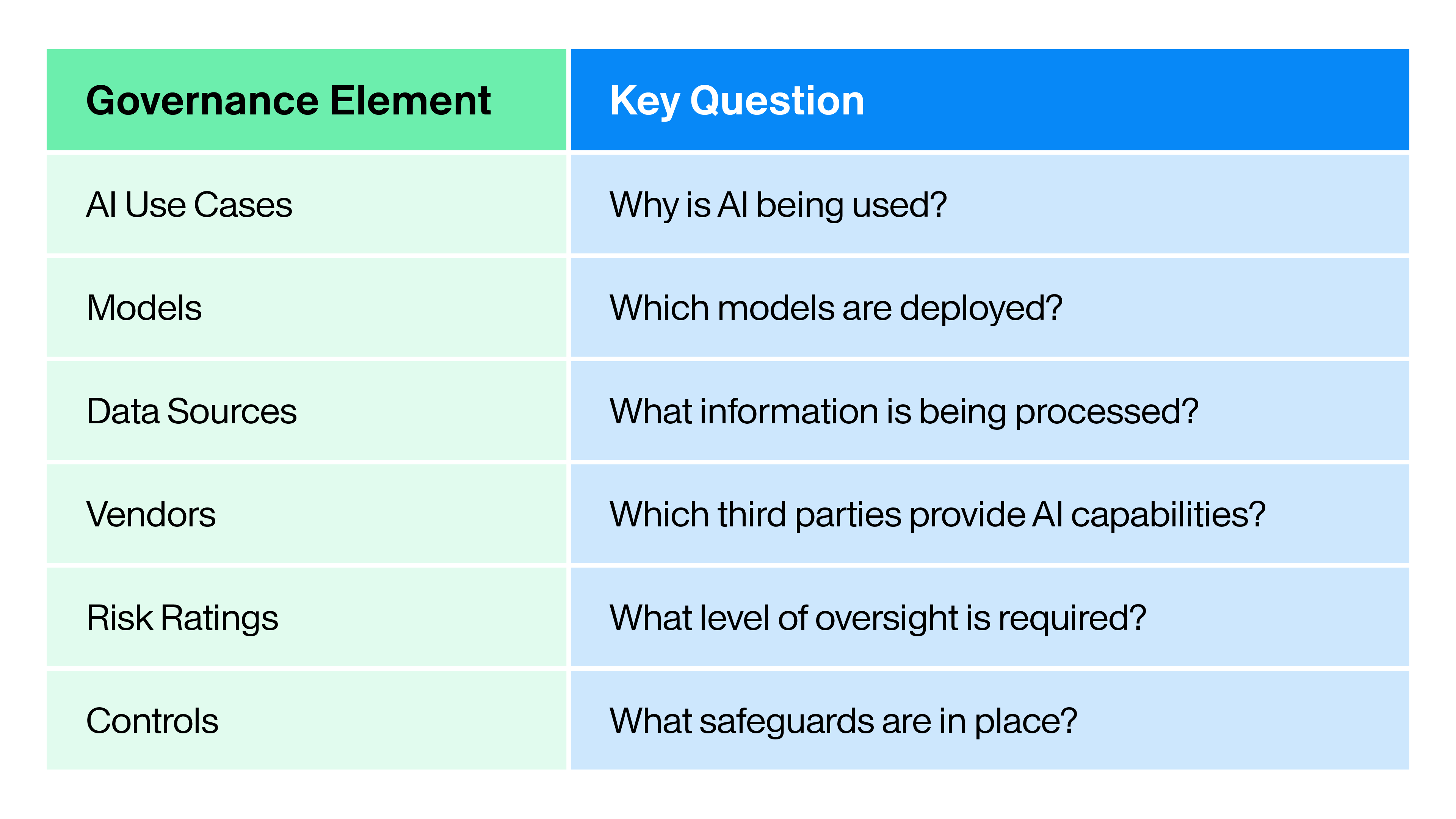

 

Table with two columns labeled “Governance Element” and “Key Question,” pairing AI governance topics with guiding questions: AI Use Cases—Why is AI being used? Models—Which models are deployed? Data Sources—What information is being processed? Vendors—Which third parties provide AI capabilities? Risk Ratings—What level of oversight is required? Controls—What safeguards are in place?


Without this visibility, governance becomes reactive. With it, organizations can begin building repeatable and scalable oversight processes.


AI Intake and Review Processes

Every new AI initiative should pass through a structured intake and review process. Security, governance, legal, privacy, and business stakeholders need a consistent way to evaluate proposed use cases before deployment.

The goal is not to create additional bureaucracy. The goal is to understand what the system is intended to do, what data it will process, whether sensitive or regulated information is involved, and how much autonomy it will be given. Establishing these factors early helps determine the appropriate level of oversight and control.

A formal intake process also creates consistency across the organization. Rather than relying on ad hoc reviews or disconnected approval workflows, teams can classify risk, assign ownership, identify required safeguards, and document decisions before systems move into production.

Key questions often include:

  • What business problem is being solved?
  • What data will the system access, process, or generate?
  • Does the use case involve regulated or sensitive information?
  • Will the AI influence customer, employee, or operational decisions?
  • Does the system take autonomous actions?

As AI adoption accelerates, standardized intake processes become one of the most effective ways to balance innovation with governance.


Move Beyond Policies to Operational Governance

Many organizations have already established AI policies and acceptable use guidelines. While these are important first steps, policies alone do not create governance.

Effective governance requires operational processes that translate policy into action.

AI risk assessments should extend beyond traditional cybersecurity concerns. Organizations need to evaluate how AI affects privacy obligations, compliance requirements, model performance, third-party dependencies, and operational resilience. AI risk is inherently multidisciplinary, which means governance cannot be owned by security teams alone.

Governance must also continue after deployment. AI systems evolve over time, business processes change, and risk profiles shift. Continuous monitoring helps organizations identify model drift, unauthorized usage, data exposure, emerging vulnerabilities, and changing compliance obligations before they become larger issues.

This shift from periodic reviews to continuous oversight reflects the broader evolution of AI governance. Rather than functioning as a series of isolated checkpoints, governance becomes embedded within the lifecycle itself.


Secure AI Across the Technology Lifecycle

Security teams should approach AI with the same discipline applied to any critical technology platform.

One of the most important priorities is protecting sensitive information. Customer data, intellectual property, source code, financial records, and regulated information should all be governed by clear policies defining what can and cannot be shared with AI systems. Data classification, access controls, and monitoring should naturally extend into AI environments rather than operating as separate programs.

Organizations must also consider the growing impact of third-party AI risk. Many enterprises consume AI through vendors rather than building models internally. As a result, AI governance increasingly overlaps with vendor risk management.

Vendor reviews should evaluate governance practices, model transparency, data handling procedures, security controls, and compliance commitments. These assessments should become a standard component of procurement, onboarding, and ongoing monitoring processes.

To create consistency, many organizations are aligning AI governance efforts with established frameworks such as the NIST AI Risk Management Framework, ISO 42001, and broader cybersecurity and risk management programs. These frameworks provide structure while allowing organizations to tailor governance controls to their specific risk profile.


Preparing for Agentic AI

The next major governance challenge is already emerging.

Agentic AI systems do not simply generate content or answer questions. They can initiate workflows, interact with enterprise systems, make decisions across multiple steps, and execute actions with increasing levels of autonomy.

This fundamentally changes the governance conversation.

Traditional governance programs focus heavily on models and outputs. Agentic systems require organizations to govern behavior. Security leaders must understand not only what an AI system produces, but also what actions it can take, what systems it can access, and what controls exist when something goes wrong.

As organizations begin deploying AI agents across customer service, software development, operations, and security workflows, governance must become increasingly embedded into the systems themselves. Runtime guardrails, continuous monitoring, observability, and automated policy enforcement become critical capabilities.

Governance can no longer operate as a periodic review process. It must function continuously and at machine speed.

Organizations that prepare for agentic AI today will be better positioned to scale AI safely tomorrow. Those that rely solely on manual approvals and centralized oversight may struggle to maintain visibility and control as autonomous systems become more prevalent.


AI Governance Enables Innovation

One of the biggest misconceptions about AI governance is that it slows innovation.

In reality, mature governance programs often accelerate adoption because expectations, controls, and approval processes are clearly defined. Teams spend less time navigating uncertainty and more time focusing on value creation.

When governance is embedded into workflows, organizations identify risks earlier, reduce approval delays, improve consistency, and generate compliance evidence more efficiently. Business stakeholders gain confidence that innovation can happen within clearly defined guardrails.

This is where governance transitions from a compliance exercise into a business enabler.

The organizations that succeed in the next phase of AI adoption will not choose between innovation and governance. They will build governance directly into the systems, workflows, and processes that enable AI to operate safely at scale.


Frequently Asked Questions


AI governance is the framework of policies, processes, controls, and oversight mechanisms organizations use to manage AI systems responsibly, securely, and in compliance with business and regulatory requirements.

AI introduces new risks related to data exposure, model misuse, regulatory compliance, third-party dependencies, and autonomous decision-making. Security leaders play a critical role in ensuring AI systems are governed appropriately and aligned with organizational risk tolerance.

An AI inventory is a centralized record of AI systems, models, vendors, use cases, and associated risks operating across the enterprise. It provides the visibility required for effective governance.

AI security focuses on protecting AI systems from attacks and vulnerabilities. AI governance is broader and includes accountability, compliance, transparency, risk management, and oversight throughout the AI lifecycle.

Governance by design embeds governance directly into workflows, systems, and decision-making processes. Rather than relying solely on manual reviews, governance becomes operationalized and scalable.

Organizations should establish runtime controls, continuous monitoring, observability, policy enforcement, and accountability structures capable of governing autonomous AI actions and decisions.


Build AI Governance Into Your Security Program

As AI adoption accelerates, governance can no longer be treated as a separate initiative. It must become part of how organizations discover, assess, deploy, monitor, and manage AI across the enterprise.

Learn how OneTrust helps organizations inventory AI systems, assess risk, automate governance workflows, and operationalize AI governance at scale. Go here to request a demo and learn more.